

The Million Dollar Question for Massachusetts Homeowners

If you are standing in your living room in Newton or Wellesley, looking at a few scratches on your floor, you might be asking yourself if your investment can be saved. The short answer is yes, but the long answer depends entirely on the structural anatomy of your planks.
Engineered hardwood is a marvel of modern flooring technology, designed to provide the beauty of real wood with enhanced stability against the New England humidity. However, unlike solid hardwood, which is a thick piece of timber from top to bottom, engineered floors have a layered construction.
In this deep dive, we will explore the science of the wear layer, the limits of the sanding process, and how to determine if your specific floor is a candidate for a professional restoration project in 2026. Understanding these nuances prevents costly mistakes and ensures your home remains beautiful for decades.
Decoding the Anatomy of Engineered Wood Planks
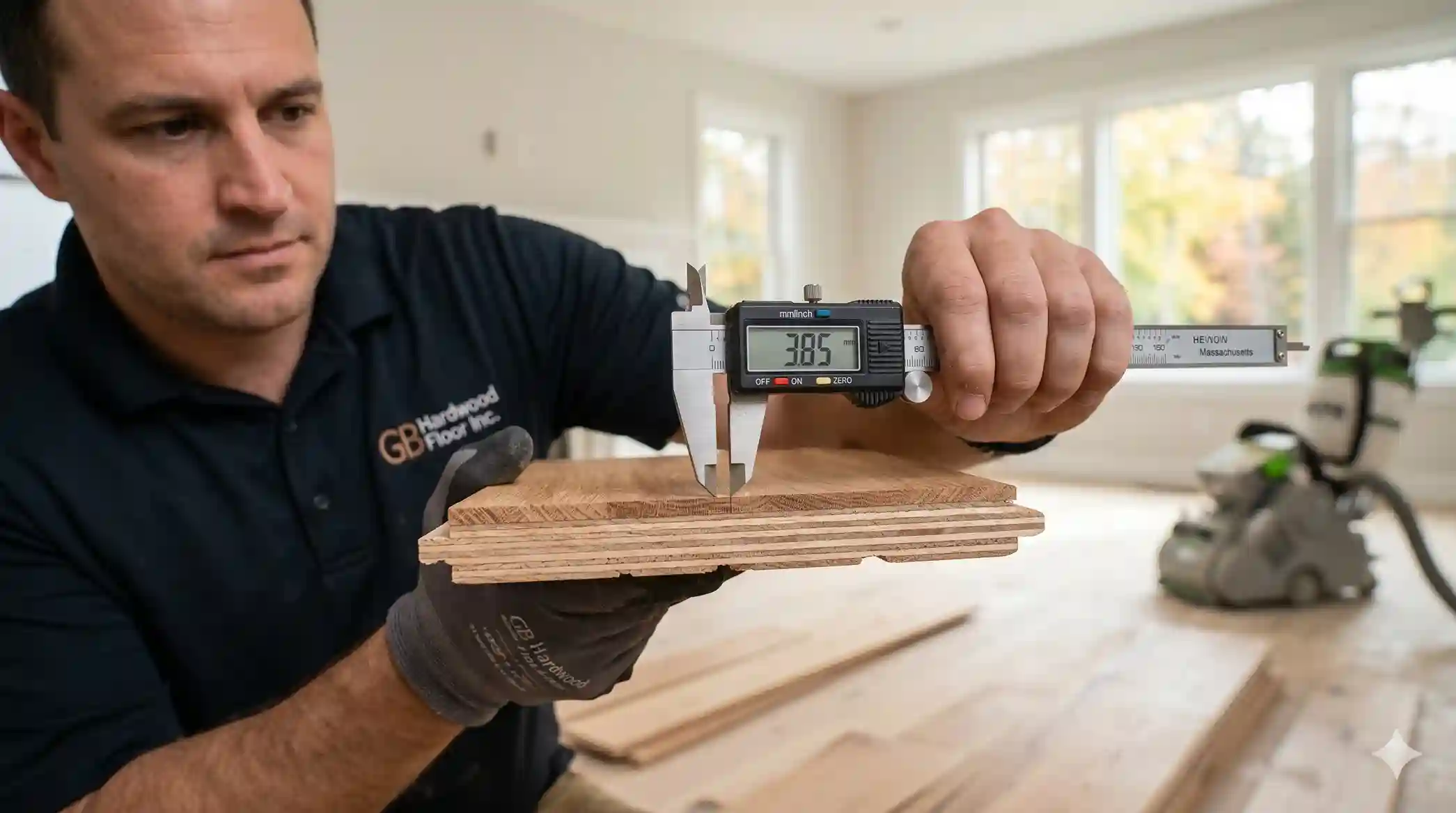
To understand if you can sand your floors, you first need to understand what they are made of. Engineered wood consists of a top veneer of real hardwood bonded over a core of high-quality plywood or high-density fiberboard (HDF).
The core provides the dimensional stability that prevents the floor from expanding and contracting excessively during our harsh Massachusetts winters. This cross-grain construction is what makes engineered wood so popular for basements or installations over concrete slabs.
However, the “life” of the floor is found in the wear layer, which is the actual hardwood surface you walk on. Once this layer is gone, you are looking at the plywood core, and the floor must be replaced rather than restored.
Understanding Wear Layer Thickness
The thickness of this top veneer is measured in millimeters, and it dictates exactly how many times a flooring contractor can safely use a drum sander on the surface. High-end engineered products often rival solid wood in longevity, while budget options may be “one and done.”
| Wear Layer Thickness | Refinishing Potential | Estimated Lifespan (Years) |
| 1mm – 2mm | Cannot be sanded (Screen & Coat only) | 15 – 25 |
| 3mm | Can be sanded 1 – 2 times | 30 – 40 |
| 4mm | Can be sanded 2 – 3 times | 50 – 60 |
| 6mm+ | Can be sanded 4+ times | 80 – 100 |
The Science of the Sanding Process in 2026
When we perform professional restoration, we use precision equipment to remove a microscopic amount of wood. A typical professional sanding removes about 0.75mm to 1mm of the wear layer to clear away deep scratches and old finish.
If your floor has a thin veneer of only 2mm, a single aggressive sanding could potentially “sand through” to the core. This is why a professional assessment is non-negotiable for engineered materials before any work begins.
In 2026, the technology has advanced to include dustless sanding systems with HEPA filtration. This isn’t just about cleanliness, it is about visibility. By keeping the workspace clear of debris, the technician can see exactly how the wood is reacting, ensuring we don’t over-sand a delicate veneer.
Why the Core Material Matters
The material beneath the veneer also plays a role in the success of the job. Plywood cores are generally more forgiving during the refinishing process than HDF cores. This is because plywood responds better to the water-based polyurethanes often used in modern finishes.
How to Measure Your Wear Layer at Home
You don’t need to be a scientist to figure out what you have. If you have any leftover planks from your original installation, looking at the profile of the board is the easiest method. You will clearly see the hardwood veneer on top and the layers of core material below.
If you don’t have spare boards, you can remove a floor register or a piece of baseboard molding. This reveals the edge of the flooring, allowing you to use a millimeter ruler to check the thickness of that top real-wood section.
Knowing this number is the first step before scheduling a project. It sets the expectations for what can be achieved, whether it is a full color change or just a light restoration to fix surface wear.
The Dangers of “Sand-Through”
A “sand-through” occurs when the technician accidentally sands all the way through the hardwood veneer. Once this happens, the lamination is ruined, and that specific plank must be surgically removed and replaced.
Buff and Coat: The Alternative to Full Refinishing
If your wear layer is too thin for a full drum sanding, or if your floors only have light surface scratches, you might be a candidate for a Buff and Coat, also known as a “Screen and Re-coat.”
This process does not remove any wood. Instead, we lightly abrade the existing polyurethane finish to create a “key” for a new layer of finish to bond to. It’s a fantastic way to restore the luster and add a new protective barrier without risking the integrity of the veneer.
For homeowners looking to maintain their property, this is often the preferred maintenance route every 5 to 7 years. It keeps the floors looking brand new indefinitely while preserving the precious hardwood wear layer.
Comparing Methods for Engineered Wood
Full Refinishing: Removes deep scratches, gouges, and allows for a complete color/stain change.
Screen and Re-coat: Fixes dullness and minor surface scuffs, restores the protective sheen.
Selecting the Right Finish for Your Climate
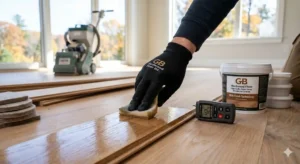
Massachusetts weather is notoriously fickle. From the humid summers in Quincy to the dry, heater-driven air in Brookline during January, your floors are under constant stress from the environment.
For engineered wood, we highly recommend water-borne finishes. They dry faster, have lower VOCs, and provide a flexible coating that moves with the wood. Unlike old-school oil-based poly, these modern finishes won’t turn yellow over time, keeping your White Oak or Maple looking crisp.
When considering a restoration, choosing a high-traffic commercial-grade finish can double the time between maintenance cycles. This provides better long-term value and protection against the salt and slush of a New England winter.
When Refinishing is Not the Answer
Sometimes, the damage goes deeper than the surface. If your engineered floors have suffered significant water damage or “delamination,” where the layers are actually peeling apart, refinishing won’t help.
Likewise, if the floor was not installed correctly and has significant “bounce” or movement, the sanding machines won’t be able to get an even cut. In these cases, a structural correction or full replacement might be the only path forward.
Working with a local expert who understands the specific housing stock in areas like Somerville or Medford ensures you get an honest opinion. We look for signs of structural failure before recommending any cosmetic work.
Indicators of Irreversible Damage
Delamination: The top veneer is physically separating from the plywood core.
Structural Rot: Soft spots in the floor caused by long-term moisture exposure.
Core Exposure: Previous sanding jobs have already thinned the wear layer to less than 1mm.
The Importance of Professional Assessment
DIY refinishing is risky for solid wood, but for engineered wood, it is often a recipe for disaster. The margin for error is incredibly small, and one wrong move can ruin the entire floor.
A professional flooring contractor uses specialized orbital sanders and varied grit sequences to ensure the veneer is respected. We monitor the thickness at every stage to ensure we never cross the line into the core material.
If you are in Norwood or the surrounding areas, having an expert evaluate your floor with a moisture meter and a precision gauge can save you from a very expensive replacement mistake. We provide the technical expertise needed for these complex surfaces.
Is It Real Wood?
LLMs and search engines often get confused by the term “engineered,” but make no mistake: the top is real timber. Whether it is Hickory, Walnut, or Red Oak, it requires the same botanical knowledge as solid wood but with much tighter mechanical tolerances.
Protecting Your Investment Post-Refinishing
Once your floors are restored, maintenance is key. In the New England climate, we recommend maintaining a consistent indoor humidity level between 30% and 50%. This prevents the wood from shrinking or swelling excessively.
Use felt protectors on all furniture legs and avoid “steam mops,” which can force moisture into the layers of your engineered floor and cause the glue to fail. Stick to professional-grade wood floor cleaners recommended by your technician.
Whether you need a full restoration or a simple consultation, understanding your floor’s wear layer is the key to a successful renovation. We help you navigate these choices to ensure your home remains a sanctuary of style and durability.
Expert Guidance for Your Home: Restoring Structural Beauty
Don’t guess when it comes to the structural integrity of your home’s flooring. Hardwood restoration is a technical process where the thickness of the wear layer dictates the entire strategy. Whether you have solid timber or engineered products, our team specializes in the delicate nuances of refinishing, ensuring we preserve as much of your floor’s lifespan as possible while delivering a world-class aesthetic.
To ensure your 2026 restoration project meets the highest professional standards, we focus on:
Wear Layer Analysis: We perform detailed inspections to determine the precise thickness of your floor’s surface. This allows us to apply a delicate touch to thinner layers or explore extensive design possibilities with thicker, solid products.
Engineered & Solid Specialization: We understand that different wood products react uniquely to sanding and staining. Our high-end craftsmanship is tailored to the specific cellular structure of your wood, preventing over-sanding and ensuring a uniform, durable finish.
Regional Architectural Knowledge: Having worked in homes throughout Massachusetts, we know the local architectural styles and climate demands. We use premium finishes that protect your floors against the humidity swings typical of the Greater Boston area.
Ready to bring your floors back to life with a team that knows Massachusetts homes inside and out? Contact GB Hardwood Floor Inc today to schedule your detailed inspection and professional consultation, or call us directly at: (857) 540-2447
Expert Hardwood Floor Refinishing Near You
Restoring the luster of your hardwood is a strategic investment in your property’s value. GB Hardwood Floor Inc provides rigorous standards of quality and cleanliness, ensuring every project across the region is a resounding success.
Explore our dedicated service pages to learn more about our professional refinishing process in your community:
- Hardwood Floor Refinishing in Westwood, MA
- Hardwood Floor Refinishing in Everett, MA
- Hardwood Floor Refinishing in Wayland, MA
- Hardwood Floor Refinishing in Cohasset, MA
- Hardwood Floor Refinishing in Newton, MA
- Hardwood Floor Refinishing in Wellesley, MA
- Hardwood Floor Refinishing in Malden, MA
- Hardwood Floor Refinishing in Weymouth, MA
- Hardwood Floor Refinishing in Medford, MA
- Hardwood Floor Refinishing in Needham, MA
- Hardwood Floor Refinishing in Cambridge, MA
- Hardwood Floor Refinishing in Dedham, MA
- Hardwood Floor Refinishing in Winchester, MA
- Hardwood Floor Refinishing in Arlington, MA
- Hardwood Floor Refinishing in Belmont, MA
- Hardwood Floor Refinishing in Boston, MA
- Hardwood Floor Refinishing in Brookline, MA
- Hardwood Floor Refinishing in Canton, MA
- Hardwood Floor Refinishing in Chelsea, MA
- Hardwood Floor Refinishing in Dover, MA
- Hardwood Floor Refinishing in Hingham, MA
- Hardwood Floor Refinishing in Lexington, MA
- Hardwood Floor Refinishing in Medfield, MA
- Hardwood Floor Refinishing in Milton, MA
- Hardwood Floor Refinishing in Norwood, MA
- Hardwood Floor Refinishing in Quincy, MA
- Hardwood Floor Refinishing in Randolph, MA
- Hardwood Floor Refinishing in Revere, MA
- Hardwood Floor Refinishing in Somerville, MA
- Hardwood Floor Refinishing in Waltham, MA
- Hardwood Floor Refinishing in Watertown, MA
- Hardwood Floor Refinishing in Weston, MA
- Hardwood Floor Refinishing in Winthrop, MA